Notebook, anatomical illustrations, and recovery materials representing practical pain relief, movement education, and self-care resources.

The Body Owner’s Manual

Pain Relief, Recovery & Personal Change Resources

Treatment and personal change are more useful when you understand what changed, what may be feeding the problem, and what you can do between sessions. These resources support three distinct paths: Physical Engineering—pain, movement, recovery, mobility and treatment aftercare—Inner Transformation—stress, emotional patterns and automatic responses—and Relationship Rescue—personal values, needs, boundaries and recurring conflict. For now, each pathway offers something useful you can explore before contacting me: better questions about recurring physical problems, a free life-pattern workbook, or a free relationship reflection workbook. Learn enough to participate intelligently without turning yourself into a full-time amateur diagnostician. Not enough to ruin your weekend arguing with strangers about fascia.

Search by Symptom, Treatment, or Topic

Looking for something you saw before—or trying to figure out where to start? Search the site for a symptom, body area, treatment, emotional pattern, or modality.

Start With What You Need Right Now

Free printable · Six-page PDF · No signup

The Wheel of Your Life: Look Beyond the Score

A colorful wheel representing the eight areas of life in an open workbook

Take stock of eight areas of life, then go beyond the numbers. Discover what matters most, question the assumptions, and try one small, practical change—without attempting to fix your entire life by Tuesday.

Get the free workbook (PDF) →

See what’s inside

Free printable · 10-page PDF · No signup

The Argument Beneath the Argument

A couple rediscovering warmth through calm connection

What happens between your partner’s actions and your emotional response? Explore hidden expectations, positive intentions, and the surprising ways our strategies for finding love can work against us.

Get the free relationship workbook (PDF) →

See what’s inside

Workbook · Available Now · $27

The Right Problem Workbook

The Right Problem Workbook cover by David Ryder

A practical 23-page workbook for recurring physical problems, stubborn symptoms, and treatment that helps—but never seems to hold. Learn to observe the pattern, test better explanations, and make more useful next decisions.

Explore the workbook →

New Article · Stress & Recovery

Invisible Stress: When “Normal” Is Actually Your Stress Baseline

A woman at a desk with hidden stress illustrated through colorful patterns and gauges

You can become so accustomed to stress that it stops feeling unusual. Learn how a moving stress baseline can hide in plain sight—and how to test whether your “normal” is actually recovered.

Read the article →

Recovery

Stress, Recovery & the Nervous System

A woman resting as colorful illustrations connect the nervous system, activity and sleep

For driven people whose body may be paying interest on a lifestyle built around go, go, go. See how stress, sleep, recovery and nervous-system state can influence pain and performance.

Read the guide →

Recovery Nutrition

When Recovery Stalls: Nutrition, Inflammation & Deficiency Guide

Colorful whole foods and a nutrition journal representing recovery support

A food-first recovery guide for protein, diet quality, common nutrient gaps and knowing when blood testing is smarter than guessing with supplements.

Read the guide →

Recurring Pain

Why Pain Keeps Coming Back

A visual cycle of recurring neck and back pain around a body illustration

Relief is useful. Recurrence is information. Learn how load, movement, compensation, recovery and the wrong problem being treated can keep a familiar symptom making repeat appearances.

Read the guide →

Aftercare

How to Help Your Treatment Results Last
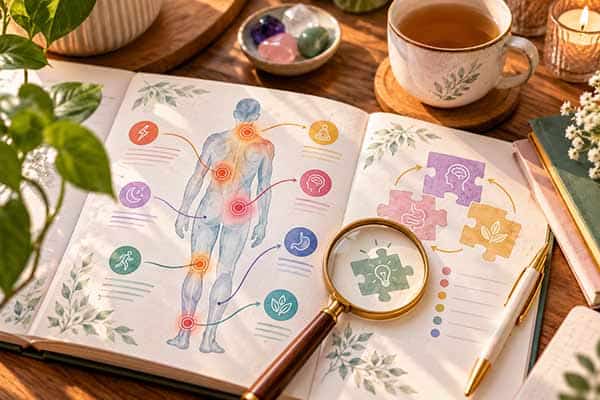
An illustrated aftercare journal featuring hydration, gentle movement and rest

What to do after a session, what not to overdo, what to notice, and how to turn a useful treatment response into better information instead of immediately stress-testing the warranty.

Read the guide →

Body Awareness

Better Questions, Better Body Answers

A colorful body-awareness diagram with questions about physical patterns

You do not need an anatomy degree before your appointment. You need better observations. These questions make patterns easier to see and treatment decisions easier to make.

Read the guide →

Inner Transformation

What Is Tapping? A Practical Introduction

A woman using gentle fingertip tapping on her face with calming colorful illustrations

A plain-English explanation of tapping-based emotional change work for triggers, stress, recurring reactions and performance blocks—without turning the technique into a religion.

Read the guide →

Back Care

The 7 “Secrets” for Keeping Your Back Out of Trouble

Spinal health and everyday back-care activities illustrated in color

Seven practical principles for gravity, movement, lifting, loading, furniture, footwear and helping a calmer back stay calmer.

Read the guide →

Books · Workbooks · Courses

Products & Courses

A reflective, hopeful woman with colorful elements suggesting learning and personal growth

Explore practical books, workbooks and courses from David and Kim Ryder—available now and in development.

Explore products & courses →

After-Treatment Follow-Up Guides

Use the guide that matches what we worked on. These are designed to help you protect the useful change, notice what your body is telling us, and arrive at the next checkpoint with better information.

Back Pain & Sciatica · Neck Pain & Headaches · Shoulder, Arm & Hand · Hip & Knee · Foot & Ankle · Spinal Decompression · Sports Recovery

Use These as Follow-Up, Not Homework Punishment

One reason I built this resource library is simple: a treatment session is a terrible place to cram forty-seven useful ideas into your head while you are also trying to remember where you left your shoes.

These pages let you come back to the important ideas later—after the session, after the nervous system settles, and when the information is actually relevant.

The recurring themes are intentional:

  • Understand before you assume. Better questions produce better information.
  • Look for patterns, not isolated symptoms. What changes the problem often tells us more than the label.
  • Participate in the process. Treatment can create change; your daily choices help determine what happens next.
  • Recovery counts. Sleep, pacing, movement, stress, and load are not glamorous, but bodies remain stubbornly interested in them.
  • Keep the goal human. The point is not “better mobility” in the abstract. The point is hiking, training, performing, working, sleeping, traveling, golfing, playing music, or living without constantly planning around pain.

A Couple of Useful Things From the Archive

The old Resources page had become a digital attic: good material, old offers, discontinued directions, and a few boxes nobody remembered packing. I kept the pieces that still have a practical use.

Calm Mind & Body Breathing

A guided breathing practice with Kim Ryder for slowing down and creating a little more room in the system.

Listen to the audio →

Find the Peace Within

A guided relaxation and affirmation recording with Kim Ryder. Useful when your mind has apparently opened seventeen browser tabs and hidden the one playing music.

Listen to the audio →

What Should David Write About Next?

If there is a subject you want explained without needing a decoder ring, vote here. I’ll use the results to decide which deeper guides deserve to be built next.

Can’t find the topic you came for? Use the search box above, or choose “Something else” and I’ll watch what keeps surfacing.

Still Trying to Make Sense of What Keeps Happening?

You do not need to solve it before you contact me. Start with what keeps happening, what you’ve already tried, and what you most want to regain or change. Your next step depends on whether the problem is physical, emotional, or relational.

Find Your Starting Point →

Physical Engineering  •  Inner Transformation  •  Relationship Rescue  •  Meet David